Timeline
Everything we have found so far about Quay Head House, oldest first. The gaps are where we need you most.
-
Before the building (to 1884)
-
c.1240
Bristol digs the river a new course
In the thirteenth century Bristol cut a new channel for the River Frome, known as St Augustine’s Trench, to give the growing port more room for ships. The northern end of that channel, where the building now stands, became the head of the quay: as far as a ship could sail into the city. The name Quay Head comes from here.
Source: Bristol24/7, The hidden river flowing underneath Bristol city centre; The Bristol Magazine, City Histories: The Lost Docks
-
1857
The river starts to disappear
The Frome had become an open sewer. After years of complaints, the stretch of river just upstream of Quay Head was covered over in 1857, creating Rupert Street. The water in front of the future building site was, for now, still open quay.
Source: The Bristol Magazine, City Histories: The Lost Docks
-
Bristol Municipal Charities (1884 to 1938)
-
1884
Built for Bristol Municipal Charities
Architects Foster and Wood design Quay Head House as offices for the trustees of Bristol Municipal Charities, who ran the city’s almshouses for the poor. It is red brick with limestone and terracotta dressings and a slate roof, in the Queen Anne style with Dutch Renaissance touches: two storeys, an attic and a basement, five windows wide. Merchant benefactors’ crests are set into the front.
Source: Historic England list entry 1372267; Bristol Archives, Bristol Municipal Charities collection
-
1893
The quay outside is covered over
Nine years after the building opened, the water in front of it vanished. The section of the Frome between Stone Bridge and the drawbridge was covered over, partly to make space for the Bristol Industrial and Fine Arts Exhibition, which drew around half a million visitors. The new ground became Magpie Park, ringed by Colston Avenue, and later the Tramways Centre.
Source: Wikipedia, The Centre, Bristol; The Bristol Magazine, City Histories: The Lost Docks
-
1895
A statue goes up across the road
A bronze statue of Edward Colston, whose crest is already on the front of Quay Head House, is unveiled on the new ground opposite. It will stand in view of the building’s windows for 125 years.
-
1932
The war memorial is unveiled opposite
Bristol’s Cenotaph is unveiled on Colston Avenue, almost directly opposite. Decades later, guests heading to a secret supper club would be told to look for the red door facing the war memorial.
-
1938
The charity moves out
After 54 years, Bristol Municipal Charities leave Quay Head House. The organisation carries on today as Bristol Charities. Where it went, and who moved in after it, is the first big question we want to answer.
Source: Bristol Culture, Cloak and Dinner (2010)
-
The missing years (1938 to 2009)
-
1938 to 1977
Who was here after the charity?
I know something about these yearsWe have found almost nothing for these years. Did the building survive the Blitz untouched? Was it requisitioned during the war? Which firms had their brass plates by the door? If you or your family worked here, we would love to hear from you.
-
1957
Traffic arrives at the front door
The Inner Circuit Road is extended north along Colston Avenue in 1957 and 1958, turning the old quayside in front of the building into a busy through road.
Source: Wikipedia, The Centre, Bristol
-
1977
Listed Grade II
On 4 March 1977 Quay Head House is added to the national list of protected buildings at Grade II, for its architecture and its place in the group of historic buildings around the Centre.
Source: Historic England list entry 1372267
-
1977 to mid 2000s
Offices, but whose?
I know something about these yearsWe know the building was still being used as offices in the mid 2000s, with the Victorian panelling and staircase intact. We do not yet know who the tenants were in the 1980s, 1990s and 2000s. Letterheads, business cards, adverts, or a memory of visiting an office here would all help.
-
Mid 2000s
Still a working office
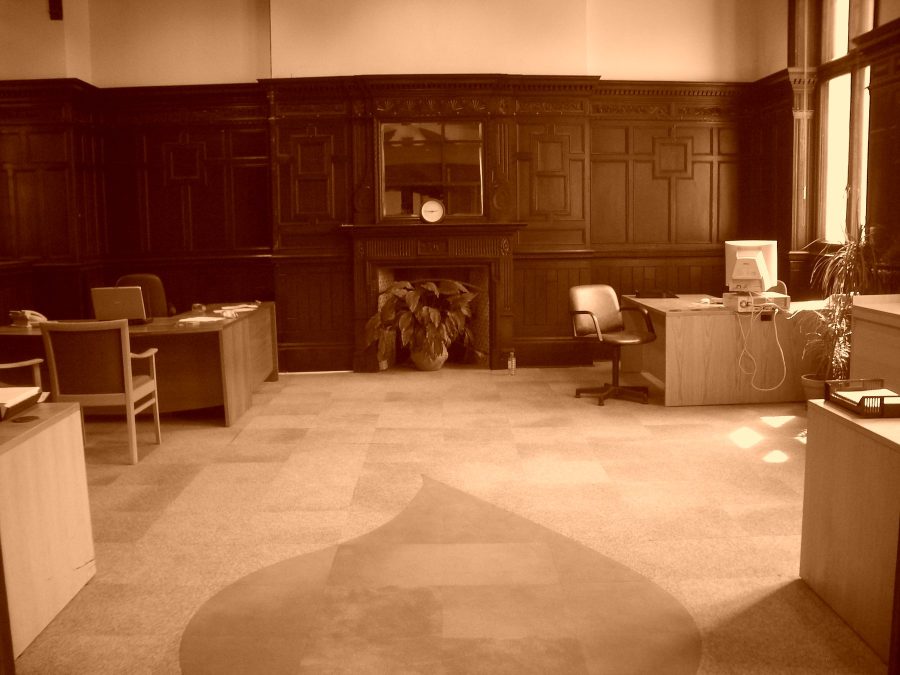
A set of ten photographs from the mid 2000s shows Quay Head House as a working office: modern desks, CRT monitors, phones and a kettle on a folding table, all set against the original carved panelling, fireplaces, overmantel mirrors and staircase. They are the only view inside the building we have from the missing years.
Source: Photographs, mid 2000s
-
Mid 2000s to 2009
Empty, then squatted
I know something about these yearsSometime in the next few years the offices emptied, and by January 2010 the building was a squat. When did the last tenant leave? How long was it empty? Who moved in, and how did a candlelit supper club end up upstairs?
-
The squat and Cloak & Dinner (around 2009 to 2011)
-
Jan 2010
A squat, and a secret supper club
For four nights at the end of January 2010, the squatted building hosts Cloak & Dinner, a pop-up restaurant run by Bristol chefs, waiters, bartenders and actors. Guests are given the location the day before, eat by candlelight in a wood-panelled room upstairs while musicians play, and pay what they think the meal was worth in an envelope. Heavy bolts are drawn back to let them out at the end of the night.
Source: Bristol Culture, Cloak and Dinner (28 January 2010)
-
The Milk Thistle (2011 onwards)
-
Sept 2011
The Milk Thistle rings its first doorbell
The team behind Clifton speakeasy Hyde & Co opens The Milk Thistle across four floors: a ground floor bar full of Victorian curiosities and taxidermy, a wood-panelled members’ lounge, an attic for private parties, and a basement vault. There is no sign outside, just a bell to ring.
Source: Bristol Culture, The Milk Thistle (20 September 2011)
-
c.2018
Among the best cocktail bars in the UK
The Milk Thistle is placed sixth in the first Top 50 Cocktail Bars list, behind four London bars and one in Edinburgh.
Source: Bristol24/7, Bristol cocktail bar named in UK top 10
-
June 2020
The statue across the road comes down
On 7 June 2020, during a Black Lives Matter protest, the statue of Edward Colston opposite the building is pulled down and rolled into the harbour. The crests on the front of Quay Head House, including Colston’s, remain part of the listed facade.
-
The distillery (2026 onwards)
-
July 2026
A gin distillery in the attic
The Spirit of Bristol, led by head distiller Pete Lumber, makes its first permanent home on the top floor. The Milk Thistle Distillery opens on 15 July 2026 with tastings, tours and gin blending sessions, and a gin and vodka made for the building.
Source: TheBusinessDesk, Top 50 cocktail bar and award-winning distillery unite in Bristol (2026)
-
Next
Your entry goes here
Every line on this page started with someone writing something down. If you remember the building, or have a photo of it, you can add the next one.
Share a photo or memory